
How much does concrete removal cost in North Carolina?
Concrete removal costs about $300 to $800 for a 10 by 10 foot slab, according to a national cost guide. The same guide puts a concrete driveway at $1,200 to $4,500 on average. Per square foot, the figures split by method. One national estimating tool starts at $11.67 to $14.22, and a second national cost guide averages about $4.
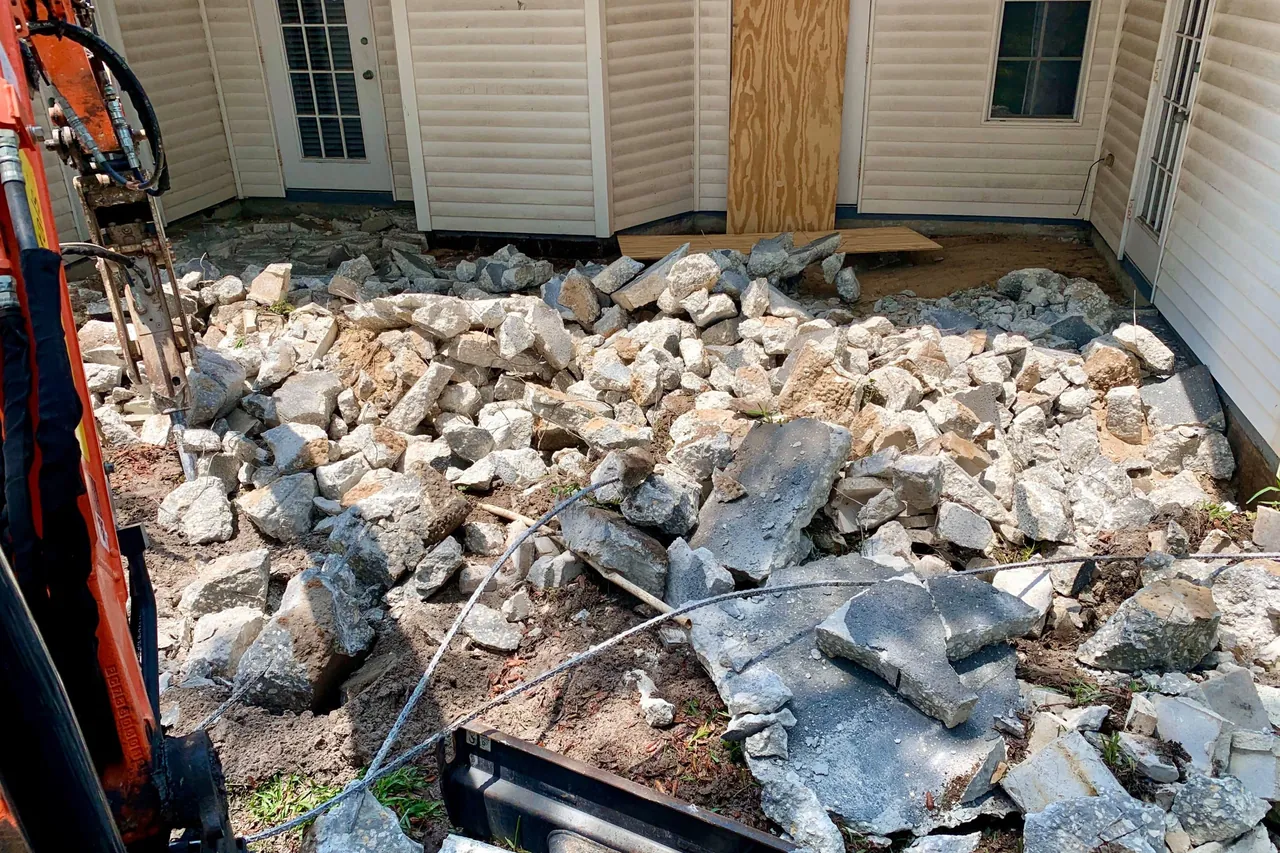
These are market numbers, not our price list. Size, thickness, rebar, access and dump fees decide where a job lands. If you have a slab, a driveway or old footings to clear, see how our concrete removal service works.
What does concrete removal cost for a driveway, patio or slab?
A national cost guide prices five common jobs. Use its ranges as a yardstick for any bid.
| Project | Published range | Kind of source |
|---|---|---|
| Concrete driveway | $1,200 to $4,500 on average | national cost guide |
| 10 by 10 foot slab | $300 to $800 | national cost guide |
| 20 by 20 foot patio | $1,200 to $3,000 | national cost guide |
| 50-foot sidewalk | $750 to $1,250 | national cost guide |
| 2-car garage floor | $1,000 to $3,500 | national cost guide |
The slab range moves with the reinforcement inside it, per the same guide. A patio attached to the house costs more to remove. A second national cost guide puts most driveway removals between $1,500 and $2,500.
If a garage or shed still stands on the slab, taking the building down is a demolition job. The slab and footings left after a teardown come out as concrete removal.
How much does concrete removal cost per square foot?
Per-square-foot figures depend on how the concrete comes out. Each source below prices a different kind of job, so match a bid to the closest one.
| How the job is priced | Published figure | Kind of source |
|---|---|---|
| Slab broken up with a jackhammer, favorable site conditions | starts at $11.67 to $14.22 per square foot | national estimating tool, 2026 |
| Typical removal | about $4 per square foot | second cost guide, 2025 |
| Thin sections lifted out by a skid steer | as low as $2 per square foot | second cost guide, 2025 |
| Large, thick sections with rebar, or cut out by hand | as high as $6 per square foot | second cost guide, 2025 |
| 10 by 10 foot slab at $300 to $800 | $3 to $8 per square foot | simple math on the first cost guide |
The estimating tool prices labor to break a slab into movable pieces with a jackhammer and remove it, reinforcing included. It also lists a daily jackhammer rental, debris disposal and a 3-hour minimum labor charge. On a small slab, that minimum spreads over fewer square feet.
What drives the price of concrete removal?
Size and thickness come first. Slabs run from a few inches thick to a full foot thick, per the second national cost guide. A thicker slab means more breaking and more tons to haul.
Reinforcement adds cost. The first cost guide says reinforced concrete costs $1 to $3 more per square foot to remove than unreinforced. The rebar or wire mesh has to be cut and hauled off with the concrete.
Access changes the hours. Open ground lets an excavator or a skid steer load the pieces straight onto a truck. A patio behind a narrow gate can mean a mini excavator, more hand work and a longer day.
Then come the loads. The first cost guide puts dump fees at $90 to $160 per ton, set by local landfill policy. In the second guide, disposal is about $0.50 to $2 per square foot, based on whether the concrete is recyclable.
Last comes what sits under the slab. East of Charlotte, that is often Piedmont red clay. Once the concrete is out, the spot needs backfill and a grade before anything new goes in. Check that a bid says who does that grading.
What does it cost to tear out and replace a slab?
The first cost guide puts a slab tear-out and replacement at $8 to $18 per square foot on average. For a 20 by 20 foot patio, that works out to $3,200 to $7,200.
That price covers two jobs: the tear-out and the new pour. Cornerstone Excavation Group handles the first one. We break out the old slab, haul it off and leave the ground graded. A concrete crew pours the new slab.
When does concrete removal need a permit or an 811 notice?
The first cost guide says you need a permit to remove concrete in the public right-of-way. The end of a driveway, or a sidewalk along the street, can sit inside the road right-of-way. Check with the town, or NCDOT on a state road, before that part is cut out. The property owner or builder holds any permit.
Digging out old footings or a foundation is excavation. North Carolina law has the person responsible for an excavation or demolition notify NC811 before it starts. That notice is due no less than three full working days ahead.
The law exempts an owner working on his or her own single-family lot, clear of any utility right-of-way or easement. NC811 still asks homeowners to call before digging, and its member utilities locate their buried lines free of charge.
Can you bury broken concrete on your lot?
North Carolina’s solid waste rules allow beneficial fill: fill used to level or bring an area to grade, using only inert debris. NC DEQ counts unpainted concrete, brick and concrete block as inert debris, along with uncontaminated soil, rock and gravel.
The catch is the digging. DEQ allows that fill only so long as no excavation occurs, and the state rule bars digging to create a fill area, so a pit dug just to bury broken slab does not qualify. Where no local ordinance covers beneficial fill, a fill done without a permit is also capped at one acre. It needs at least one foot of compacted soil on top. It cannot go in waters of the State or at or below the seasonal high groundwater table.
Whether your load qualifies is for you to confirm with NC DEQ. Ask the county or town about local rules too. Most jobs haul the concrete off instead. Loading the pieces onto dump trucks and taking them away is part of our material hauling work.
Is it cheaper to remove concrete yourself?
On a small, thin slab, it can be. The do-it-yourself route means renting a jackhammer or a breaker, cutting any rebar and loading heavy pieces. The second national cost guide warns that renting jackhammers gets expensive because the project takes many hours.
Then the pieces need a truck or trailer that can carry the weight. Dump fees are charged by the ton. On a driveway or a reinforced garage floor, the hours and the fees add up fast.
How do you get a real number for your concrete removal?
Published ranges only go so far. What you pay depends on the slab itself and the site around it. Before we give you a number, we come out and look at the job, and the estimate is free.
Cornerstone is based in Indian Trail, on the east side of Charlotte, and 5.0-rated on Google. We break up and dig out driveways, patios, walkways, slabs and old footings. Then we haul the concrete off and grade the ground for the next crew or the yard. Call (980) 315-5707, or read more about concrete removal in Indian Trail and the Charlotte metro.