
Retention Pond vs Detention Pond: What’s the Difference in North Carolina?
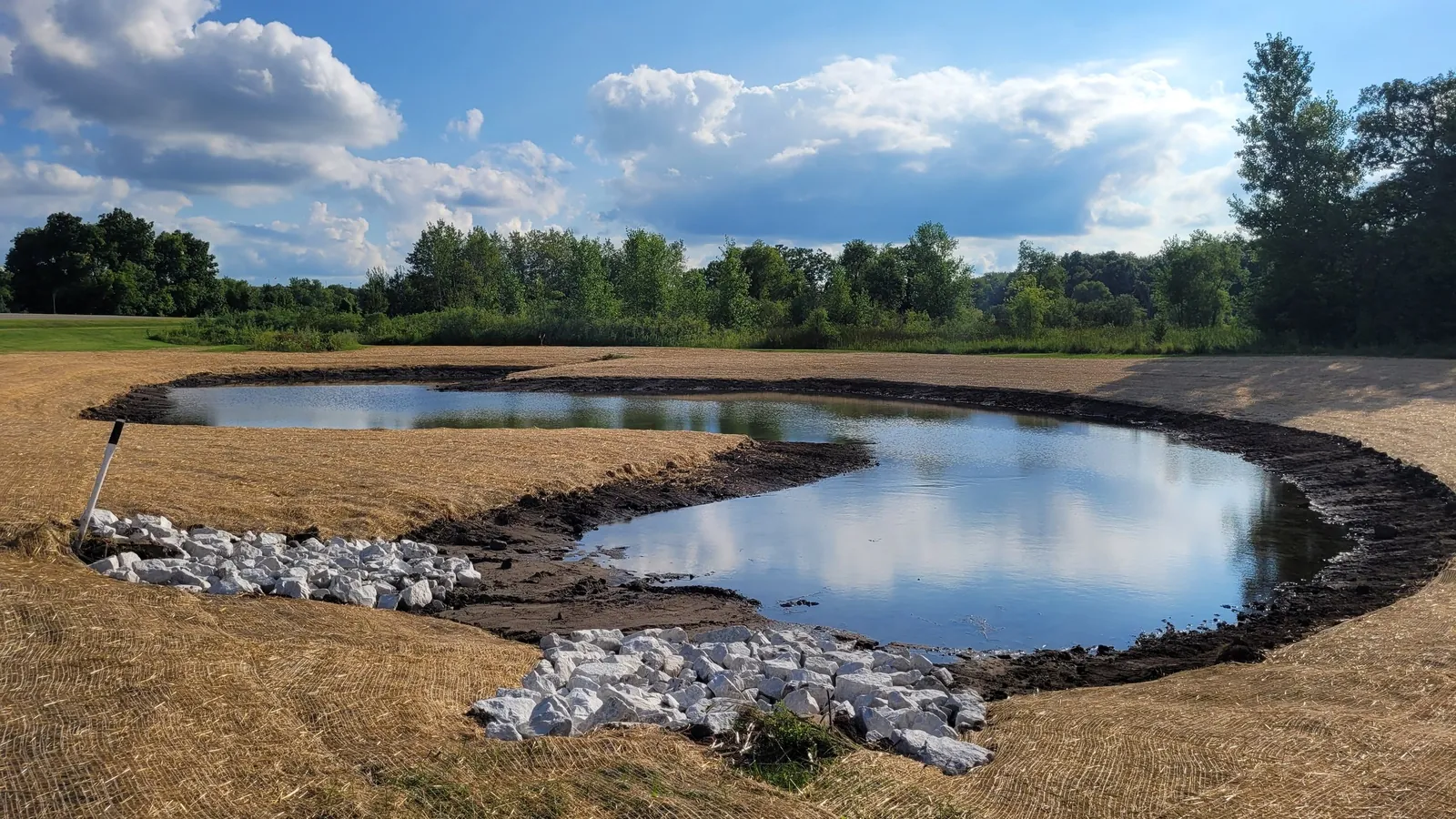
A retention pond holds water all the time. A detention pond holds storm runoff for two to five days, then drains almost dry. North Carolina’s stormwater rules call the first a wet pond and the second a dry pond.
The wet pond treats runoff by holding it in a permanent pool while sediment settles out. The dry pond’s main job is to cut and delay the peak flow after a storm. North Carolina’s Department of Environmental Quality (DEQ) counts it as a secondary stormwater control measure, or SCM. DEQ also rates its pollutant removal as low.
Either way, an engineer designs the pond and the owner or developer gets it permitted. Cornerstone Excavation Group does the dirt side: pond excavation and grading to the approved plan. This guide explains the state rules. It is not a design or legal opinion.
What is a retention pond in North Carolina?
The U.S. Environmental Protection Agency (EPA) says wet ponds are also called stormwater ponds or wet retention ponds. North Carolina’s rule for them is 15A NCAC 02H .1053, which took effect January 1, 2017.
A wet pond’s first outlet sits above the pond bottom. That creates the permanent pool, the water that stays between storms. Runoff flowing in mixes with the pool, and sediment settles out. DEQ’s design manual says most pollutants are removed through that settling.
A vegetated shelf runs around the main pool, at least 6 feet wide and no steeper than 6:1. It is planted with at least three native species, at 50 plants per 200 square feet. The plants discourage waterfowl and protect the shoreline. DEQ adds that the shelf discourages children from entering the pond.
What is a detention pond in North Carolina?
A detention pond is what North Carolina’s rules call a dry pond. DEQ’s design manual also uses the name dry extended detention basin. Its main purpose is to cut and delay runoff peaks. It holds water right after a storm, then drains almost completely dry between storms.
The dry pond rule is 15A NCAC 02H .1062. The pond’s lowest point has to sit at least 6 inches above the seasonal high water table. With less separation, DEQ says pools of standing water can form in wet weather. The bottom is graded uniformly toward the outlet, which keeps water from ponding inside.
DEQ says a dry pond can pair with another SCM, such as a bioretention cell, in a treatment train. It can also manage peak runoff.
How do North Carolina’s wet pond and dry pond rules compare?
Here are the two state rules side by side. The last two rows come from rule .1050, which covers every SCM.
| Item | Wet pond (retention pond) | Dry pond (detention pond) |
|---|---|---|
| Between storms | A permanent pool stays | Drains almost dry |
| Main job | Holds runoff so sediment settles out | Cuts and delays runoff peaks |
| Pollutant removal | Most pollutants settle out in the pool | Low; DEQ calls it a secondary SCM |
| Depth | Main pool averages 3 to 8 feet | Temporary pool 10 feet at most |
| Drawdown | Back to the permanent pool in 2 to 5 days | Design volume drains in 2 to 5 days |
| Pretreatment | A forebay holding 15 to 20 percent of the main pool volume | Required; a forebay is most recommended at 20,000 cubic feet or more |
| Grading | A shelf at least 6 feet wide, 6:1 or flatter; at least 6 inches of sediment storage | Bottom graded uniformly toward the outlet |
| Water table | No seasonal high water table requirement | Lowest point at least 6 inches above it |
| Outlet | The first outlet sits above the bottom, which holds the pool | A small pool near the orifice, plus a debris screen |
| Dam and embankment | Non-clumping turf grass, no trees or woody shrubs | Same as a wet pond |
| Side slopes | No steeper than 3:1 | No steeper than 3:1 |
| Maintenance access | At least 10 feet wide | At least 10 feet wide |
The maintenance access has to reach the nearest public right-of-way.
Who owns and maintains a stormwater pond?
Under rule .1050, the owner of an SCM signs an Operation and Maintenance Agreement. That agreement is recorded with the county Register of Deeds. A residential lot with an SCM carries a note on its plat. It warns that removing or changing the SCM without approval can bring enforcement.
Under the wet pond rule, the forebay is cleaned out once sediment cuts its depth below 75 percent of design. DEQ’s sample upkeep plans for both pond types call for an inspection every quarter. They add one inside 24 hours of any storm over 1.0 inch, or 1.5 inches in a coastal county. A dam safety expert should also inspect the embankment once a year.
Local rules sit on top of the state’s. In Gastonia, projects over one acre need stormwater control measures and City permitting. The Town of Stallings has its own post-construction stormwater ordinance, Chapter 52. Its stormwater utility fee pays for inspections of detention ponds and other stormwater infrastructure.
In Charlotte, the City says long-term maintenance of all SCMs is required by the City and County. Annual inspection reports are generally required for SCMs built after 2007.
What does building a retention or detention pond involve?
The engineer’s plan sets the grades, elevations, slopes and outlet. Cornerstone does the dirt work to that approved plan.
Erosion control goes in before the dig. Under state law, disturbing more than one acre needs an approved erosion and sedimentation control plan. The plan is filed 30 or more days before the work starts. We put in the erosion control measures the plan shows.
Before any digging, state law calls for notice to NC811 at least three full working days ahead. Then the crew cuts the basin and builds the embankment. The forebay and main pool are dug to the depths on the plan.
On a wet pond, the shelf is graded to its set width and slope. On a dry pond, the bottom is graded evenly toward the outlet. We set the outlet structure at the plan’s elevations.
The side slopes and the maintenance access are graded to the plan as well. Last comes stabilization of the bare ground. DEQ says a dry pond should be stabilized within 14 days after construction ends.
On a commercial job, the pond is one piece of the commercial site work. One of our own jobs was a stormwater management pond for a commercial property in Indian Trail. It included a sand filter and precise grading, built to the design requirements to pass inspection.
How does Cornerstone help with a stormwater pond?
Cornerstone is based in Indian Trail, on the east side of Charlotte, and 5.0-rated on Google. We dig and grade retention and detention ponds to the engineer’s approved plan. Every estimate is free and starts with an on-site look at the job. Call (980) 315-5707, or see our pond excavation page.