
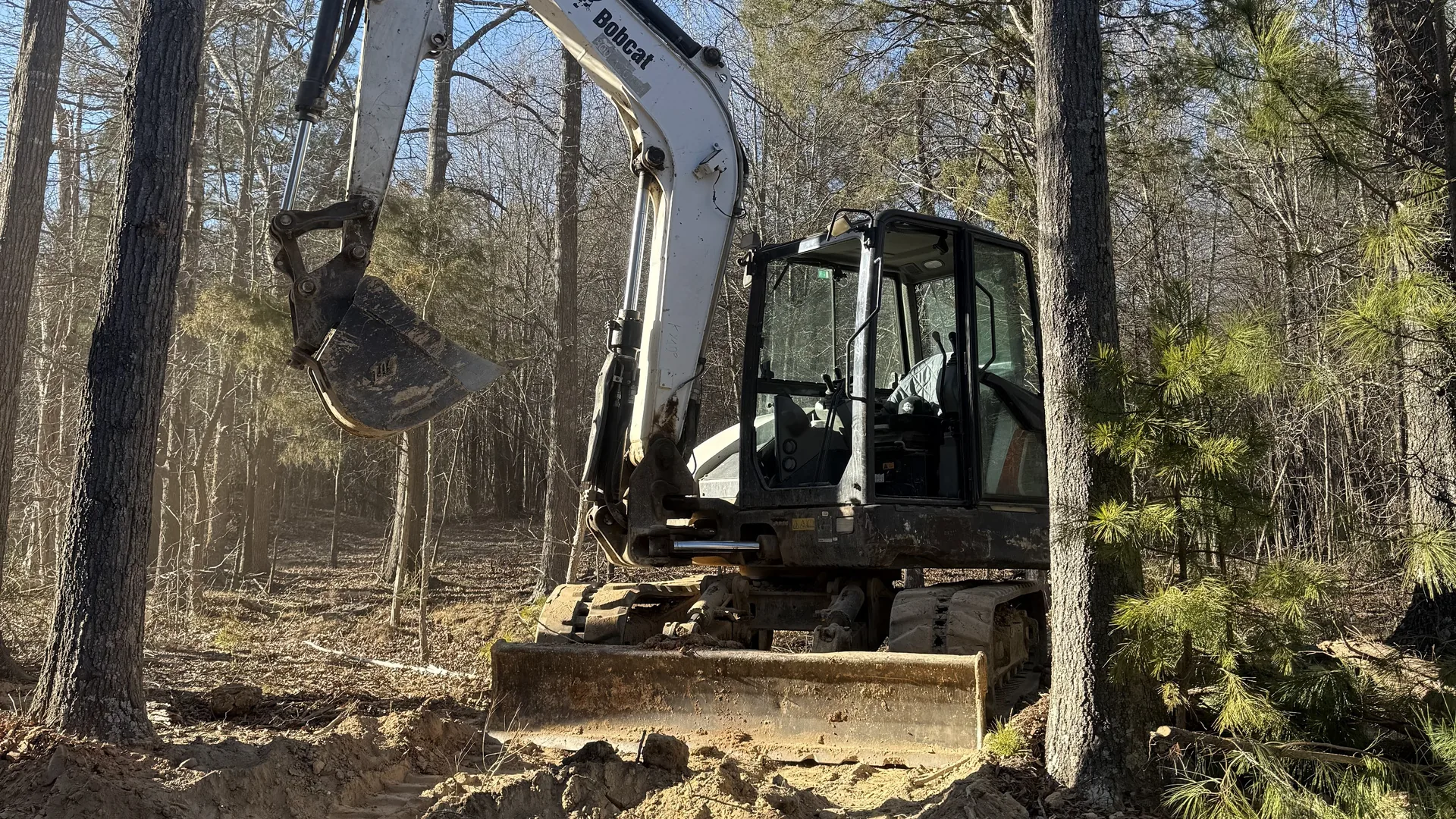
How Much Does Land Clearing Cost Per Acre in North Carolina?
Most land clearing in North Carolina runs about $1,200 to $6,000 per acre. That spread comes from 2026 pricing guides published for the North Carolina market. National cost guides land in the same neighborhood. They put lightly wooded ground at roughly $733 to $2,333 per acre. Heavily wooded ground with mature trees runs about $3,395 to $6,155 per acre.
Those are market numbers, not our price list. No two acres price the same, so we quote after we see the lot. Use the ranges below to build a budget, then get a real number from a contractor.
What does land clearing cost per acre in North Carolina?
Price follows what is standing on the ground, not the acre count alone. An acre of tall grass and vines is a short job. An acre of mature hardwoods with stumps is a different job entirely.
Here is how published 2026 figures line up by density.
| What is on the acre | Published range per acre | Kind of source |
|---|---|---|
| Light brush, grass and vines | $580 to $2,333 | national cost guides |
| Mixed brush with small trees | $1,500 to $3,500 | 2026 clearing cost guides |
| Heavy woods, mature trees and stumps | $3,300 to $6,155 | national cost guides |
| Forestry mulching, light to medium growth | $1,000 to $3,500 | North Carolina published figures |
| All densities, North Carolina overall | $1,200 to $6,000 | North Carolina published figures |
Brush-only work sits at the bottom of that table. One national guide puts brush removal near $330 to $630 per acre. Hourly pricing shows up too, around $110 to $265 per hour. Most land clearing jobs around Charlotte get quoted by the lot instead of by the hour.
One North Carolina figure looks far lower, and it pays to know why. NC State Extension puts forest site preparation at $45 per acre for burning. Mechanical methods run over $200 per acre. That work is cut-over timberland being prepped for replanting. It is not a wooded lot being cleared and grubbed for a house.
What makes one acre cost more than another?
Six things move the number on a Piedmont lot:
- Tree size and count. Big hardwoods take more machine time and make far more debris.
- Stumps and roots. Pulling them is called grubbing, and it doubles the handling on a wooded acre.
- Slope and access. A tight backyard lot costs more per acre than an open field.
- Rock. The Carolina Slate Belt runs through Union County, so shallow rock shows up in some digs.
- Debris volume. Everything that comes down has to go somewhere, and that cost tracks tonnage.
- Tract size. Published guides report per-acre rates falling 15 to 25 percent on ten acres or more.
Season matters too. Winter clearing moves faster because the brush is down and the leaves are off. Wet red clay in a Piedmont spring slows every machine on the site.
How much do stumps and debris haul-off add?
Stump removal is usually its own line item. National cost guides put a single stump near $130 to $350. One guide reports an average around $326, then $40 to $83 for each stump after that. A wooded acre holds dozens of stumps, so contractors normally price grubbing into the acre rate.
Debris is the other add-on. Published guides put full haul-away, meaning loading, trucking and dumping, at roughly $200 to $500 per acre. A single loaded dump run often falls between $200 and $800. Landfill tipping fees drive part of that, commonly $55 to $180 per ton for mixed construction debris. Hauling debris off site is the clean option when the lot has to end up build-ready.
Burning on site is cheaper where it is allowed. North Carolina lets you burn vegetation that came off that same site, under NC DEQ air quality rules. Those rules are specific. A land clearing burn pile must sit at least 500 feet from occupied structures. It must sit at least 250 feet from a public road when the wind blows that way. Burning runs 8 a.m. to 6 p.m. only, and only on Code Green or Code Yellow air days. Local ordinances can restrict it further, so check with the county first.
Is forestry mulching cheaper than conventional clearing?
Usually yes, going by published figures. A forestry mulcher grinds standing brush and small trees into a chip layer that stays on the ground. There is no pile to load and no load to dump.
Cost guides put mulching near $500 to $2,000 per acre for light brush. Medium growth with trees under about six inches runs near $1,500 to $3,500. Heavy timber pushes past $4,000 an acre. Guides commonly report mulching landing 20 to 40 percent under conventional clearing, mostly from the skipped hauling.
Mulching has a real limit. It leaves stumps and roots in the ground and a mat of chips on top. That works for a trail, a pasture edge or a view. It does not work under a house pad. Once the lot becomes site prep and building pads, the stumps come out and the ground gets graded clean.
What is the cheapest way to clear land?
Clear only what the project needs. Marking the build footprint, the drive and the drainage path keeps the acre count accurate.
After that, the levers are simple. Mulch whatever can stay as mulch. Burn on site where the county allows it. Clear the whole tract in one mobilization rather than in pieces. On a larger wooded tract, merchantable timber can sometimes be sold first, which offsets part of the bill.
What else belongs in the clearing budget?
Grading is the usual follow-on, since cleared ground is rarely ready to build. National guides put a residential grading job near $800 to $4,000. We break that down in our post on land grading costs in North Carolina.
Erosion control comes next. North Carolina’s Sedimentation Pollution Control Act requires an approved erosion and sediment control plan once land disturbance reaches one acre. NC DEQ runs that program, and Mecklenburg, Union and Cabarrus counties run delegated local programs. Confirm the threshold, the plan fee and the review time with your county.
Tree rules apply inside city limits. Charlotte has a tree ordinance, and other towns set their own. Check the city’s tree rules before clearing a lot in town.
Utility locates are free but not instant. A locate request goes to NC811 before any digging starts. Confirm the current notice window with NC811.
Getting a real number for your acre
A published range gets you a budget. A quote needs eyes on the lot.
Cornerstone Excavation Group is an excavation contractor based in Indian Trail, on the east side of Charlotte. We work the Charlotte metro, Union County and the York County side of South Carolina. We are 5.0-rated on Google, and estimates are free.
Call or text (980) 315-5707 to talk through your property, or read more about clearing and grubbing work.